
Upholding the right to education in a transforming world: Reflections from the outgoing Chair of UIL’s Governing Board

As his term as Chair of the UIL Governing Board comes to a close, Daniel Baril reflects on the strategic priorities, achievements and enduring challenges that have shaped his tenure.

© UNESCO Institute for Lifelong Learning

Last 1 January marked the end of my term as Chair of the Governing Board of the UNESCO Institute for Lifelong Learning (UIL). It was an honour to chair an institute that holds a unique place within the UNESCO system.

Since its founding in 1952, UIL has provided recognized intellectual leadership to UNESCO Member States and to the international adult education community. It helps shape both reflection and action on lifelong learning, while carrying a vital responsibility: defending and advancing the right to adult education. Serving as Chair of its Governing Board, therefore, comes with both an opportunity – and a duty – to keep this mandate alive in today’s context.

My term, which began in January 2020, unfolded amid a period of rapid transformation in the education landscape. Throughout it, I sought – within my means – to promote two perspectives that I considered strategic.

The first concerns the profound evolution of lifelong learning realities. Ways of learning are diversifying under the combined influence of digital technologies and artificial intelligence. At the same time, learning design now offers a broad spectrum of modalities – face-to-face, online, hybrid and blended – and an expanding range of formats, from microlearning to full-length programmes. Practices are also evolving: self-directed learning, peer learning, learning communities, recognition of prior learning, and more. In this context, I considered it essential that UIL embrace these developments as broadly as possible to remain closely aligned with lived realities and with the futures of adult learning.

The second perspective lies at the heart of UIL’s historic mission: the defence of the right to education. A striking paradox defines our era. On the one hand, we now have an unprecedented array of educational resources, pedagogical approaches and technological capacities that could, in principle, meet everyone’s learning needs. On the other hand, dramatic inequalities persist – whether in access, quality, continuity of learning pathways or recognition of learning. I therefore made it a point, whenever the opportunity arose, to reaffirm a simple requirement: educational resources should serve to strengthen the effective conditions for exercising the right to education – not the other way around.

Certain milestones stood out as defining moments of this term. The Seventh International Conference on Adult Education (CONFINTEA VII), held in 2022, was one of them. Through my participation in the conference’s organizing committee and my role as Chair of the drafting committee for its final declaration, I was able to support a broad vision of adult learning and education – one that expands the educational capacity that people can mobilize to make the right to adult education real. In this same spirit, the emphasis placed on financing in the Marrakech Framework for Action, as well as the open approach to expanding the domains of learning, clearly reflect these concerns.

At the end of these years, I take one thing above all: serving as Chair and spokesperson for UIL’s leadership in promoting an ambitious understanding of lifelong learning – rooted in the implementation of the right to education – was an honour.

But chairing UIL also means grasping how fragile the resources are that sustain such an essential mission. A competent and committed team cannot support Member States in implementing lifelong learning policies without adequate financial means. I leave this term with a clear sense of a persistent tension: that of a fundamental mission, carried forward with conviction, confronted with limited resources that too often impose difficult trade-offs.

The evolving right to education in the age of generative AI

In his October 2025 address at the Shanghai Open University 2025 International Conference on Digital Lifelong Learning, Daniel Baril, Chair of the UNESCO Institute for Lifelong Learning Governing Board, explored how generative artificial intelligence (AI) and digital technology are fundamentally transforming education – and why this necessitates an updated framework for the right to education. This blog summarizes his remarks.

© Shutterstock_SvetaZI

What has changed

Generative AI has moved rapidly from the periphery to the centre of educational practice in just two years. While public education systems continue to pilot these technologies cautiously, well-funded private edtech companies and AI vendors are advancing quickly, creating pressures around speed, personalization and scale that challenge public institutions.

Two critical developments merit attention. First, AI-assisted self-regulated learning is becoming widespread among adults. Recent research shows that approximately 10 per cent of adults globally use ChatGPT, with 49 per cent of interactions focused on learning activities, including tutoring, creative development, health and cooking. This represents a significant shift towards self-directed learning enabled by generative AI.

Second, a ‘replacement phenomenon’ is emerging, as general-purpose AI platforms absorb functions previously performed by specialized edtech companies. Major AI firms – Anthropic, OpenAI and Google – have launched educational services, blurring the boundaries between AI platforms and edtech. This convergence threatens to reshape market dynamics and governance structures, potentially disrupting both traditional education systems and the edtech sector itself.

The trajectory is moving from episodic, provider-led instruction to blended, conversational, multimodal learning environments accessible anytime, anywhere –offering unprecedented opportunities to realize the ideals of lifelong learning.

Emerging learning technologies

Three transformative technologies are reshaping education:

  • Intelligent virtual assistants now function as always-on tutors and coaches, providing immediate access to knowledge, scaffolded help, and adaptive support across topics and languages.
  • Modern learning management systems now incorporate AI to automate content curation, infer learners’ skills, adapt learning pathways and deliver personalized feedback at scale.
  • AI-generated immersive content enables the creation of lessons, assessments and augmented/virtual reality simulations from simple prompts – lowering production barriers and enabling safe, repeatable practice experiences.

Together, these technologies expand access, enable real-time personalization and support authentic learning at scale. However, they also shift the cognitive and social dimensions of learning, placing greater emphasis on metacognition and AI literacy, as learners increasingly ‘converse with knowledge’. In this context, educators are moving towards coaching and facilitation roles while safeguarding inclusion and educational integrity.

In this rapidly shifting landscape, generative AI has come to the forefront of learning, reshaping how adults direct their own learning and how emerging technologies redefine teaching, personalization and the broader edtech ecosystem. These transformations invite a renewed reflection on how best to effectively deliver the right to education.

A right to education for the generative AI age

UNESCO’s 2021 initiative to evolve the right to education responds to the realities of the twenty-first century. Digitalization has expanded access to learning while exposing vulnerabilities in connectivity, accessibility, data protection and linguistic diversity. The initiative aims to extend the right to education across all ages and learning settings, operationalize the traditional ‘4 As’ (availability, accessibility, acceptability, adaptability) in digital contexts, and introduce accountability as a fifth principle.

Current policy debates focus on enshrining learning continuity, recognizing and validating all forms of learning, treating connectivity and digital devices as guaranteed common goods, embedding digital safeguards, ensuring digital literacy, clarifying rights around adult reskilling, regulating digital provision and protecting vulnerable populations.

The COVID-19 pandemic accelerated digital transformation dramatically. By October 2020, 1.6 billion learners had been displaced and 90 per cent of countries had adopted some form of online instruction. This pivot revealed deep inequalities in access to devices and connectivity, particularly in sub-Saharan Africa, rural areas and among marginalized populations.

Generative AI amplifies the urgency of these challenges. As AI firms increasingly take on the role of education service providers, questions arise about privatization, standards, accountability and the public interest. Safeguarding the right to education demands policy frameworks that promote equity, quality, protection and learner autonomy.

Conclusion

Realizing the promise of AI in education requires intentional design and public governance. Without these, risks include opacity, exclusion and default privatization. To counter this, we must advocate for public AI infrastructure – public algorithms, datasets and learning platforms – to ensure inclusive, equitable and quality learning opportunities throughout life.

The goal is ‘co-intelligence’, combining the best of artificial intelligence capabilities with the best of human intelligence, guided by a rights-based public mission to achieve UNESCO’s vision of lifelong learning for all, as set out in Sustainable Development Goal 4.

Creating upskilling opportunities for 144 million Indonesians

Ahead of the Inclusive Lifelong Learning Conference, hosted by the Government of Indonesia and the UNESCO Institute for Lifelong Learning from 3 to 6 July 2023 in Bali, Indonesia, Denni P Purbasari, Executive Director at Kartu Prakerja, Indonesia’s lifelong learning programme, explains how training and upskilling initiatives are changing lives in Indonesia.
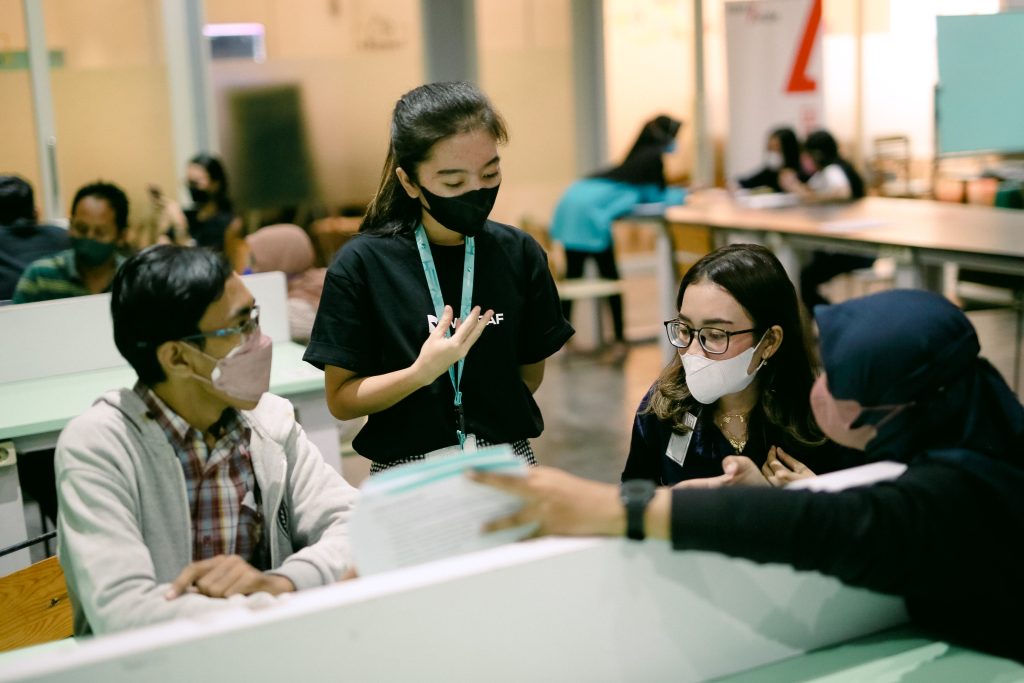
© Prakerja

Sianny, a 56-year-old administration worker, found herself struggling financially after the COVID-19 pandemic caused her office to shut down, leaving her jobless. Despite the challenges she faced, Sianny was able to support herself by utilizing her cooking skills, gained by attending free local government training programmes. Ultimately, she was able to reinvent herself as a micro-entrepreneur, selling food to local farming groups.

Continue reading